You deliver faster
Passages you have already translated come back as they were. The rest arrives drafted: to review, not to write.
AI pre-translation · 100% local
Thinkitrad drafts the first version of your translations on your own machine, in the original layout and with your own memory. You review, you correct, you sign.
No cloudWord, PDF, scanned documentsArabic and reading direction included
Video
An Arabic civil-status certificate sent in by a client, pre-translated, reviewed and certified. Then a second certificate, where what the translator corrected comes back on its own. The real product, on fictitious data.
Let's try it on your own documents.
Join the pilot programmeNo sound. The pre-translation is sped up in the edit.
What changes
Passages you have already translated come back as they were. The rest arrives drafted: to review, not to write.
Tables, headings, bold, the right-to-left direction of Arabic: the layout is kept. Nothing to reformat afterwards.
Your TMX memories, bilingual spreadsheets and glossaries are imported: years of work stop gathering dust on a drive.
Certificates, identity papers, medical records, litigation: the work you could not hand to an online service.
Features
Pick a step: every screen is the real application, filmed on fictitious data.
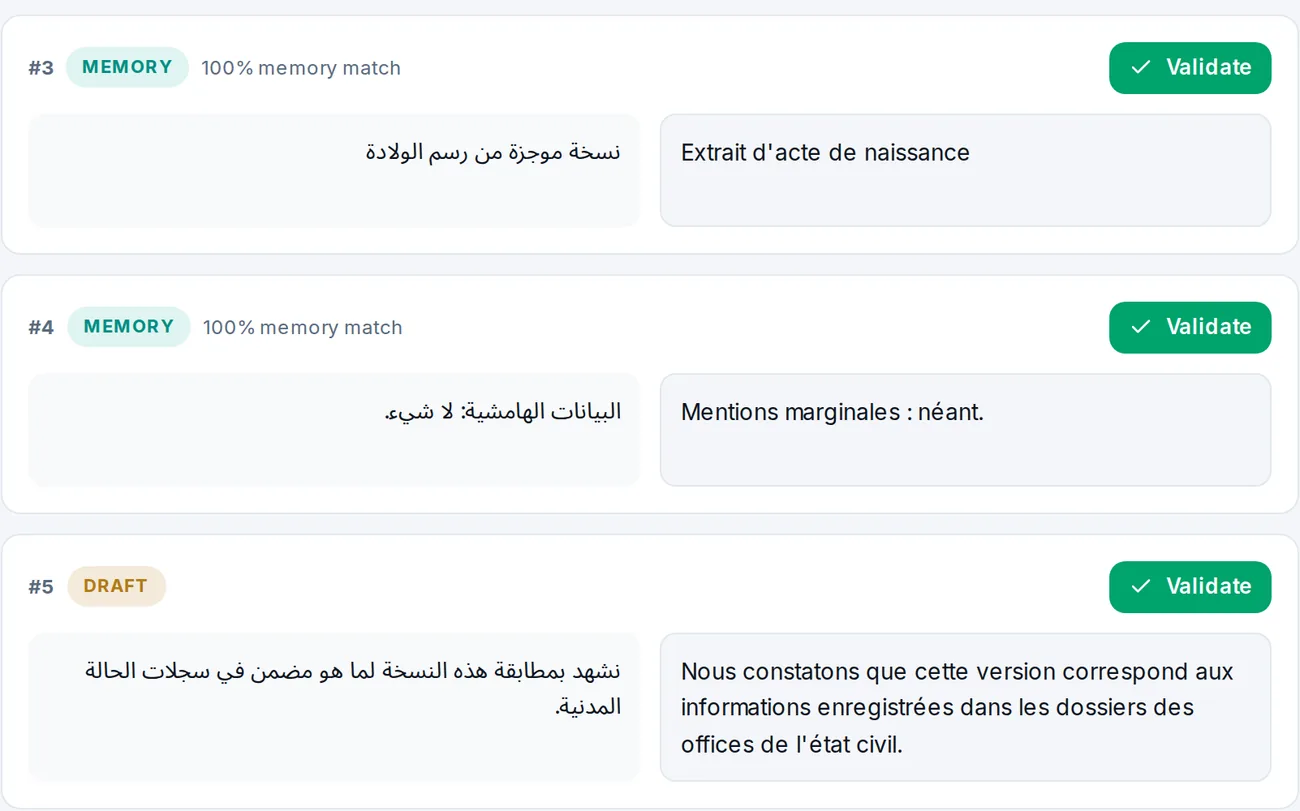
Every segment arrives translated. Those your memory knows are reused as they are; the others are drafted by the local model, from your closest past translations.
Every segment says where it came from: “memory” or “draft”.
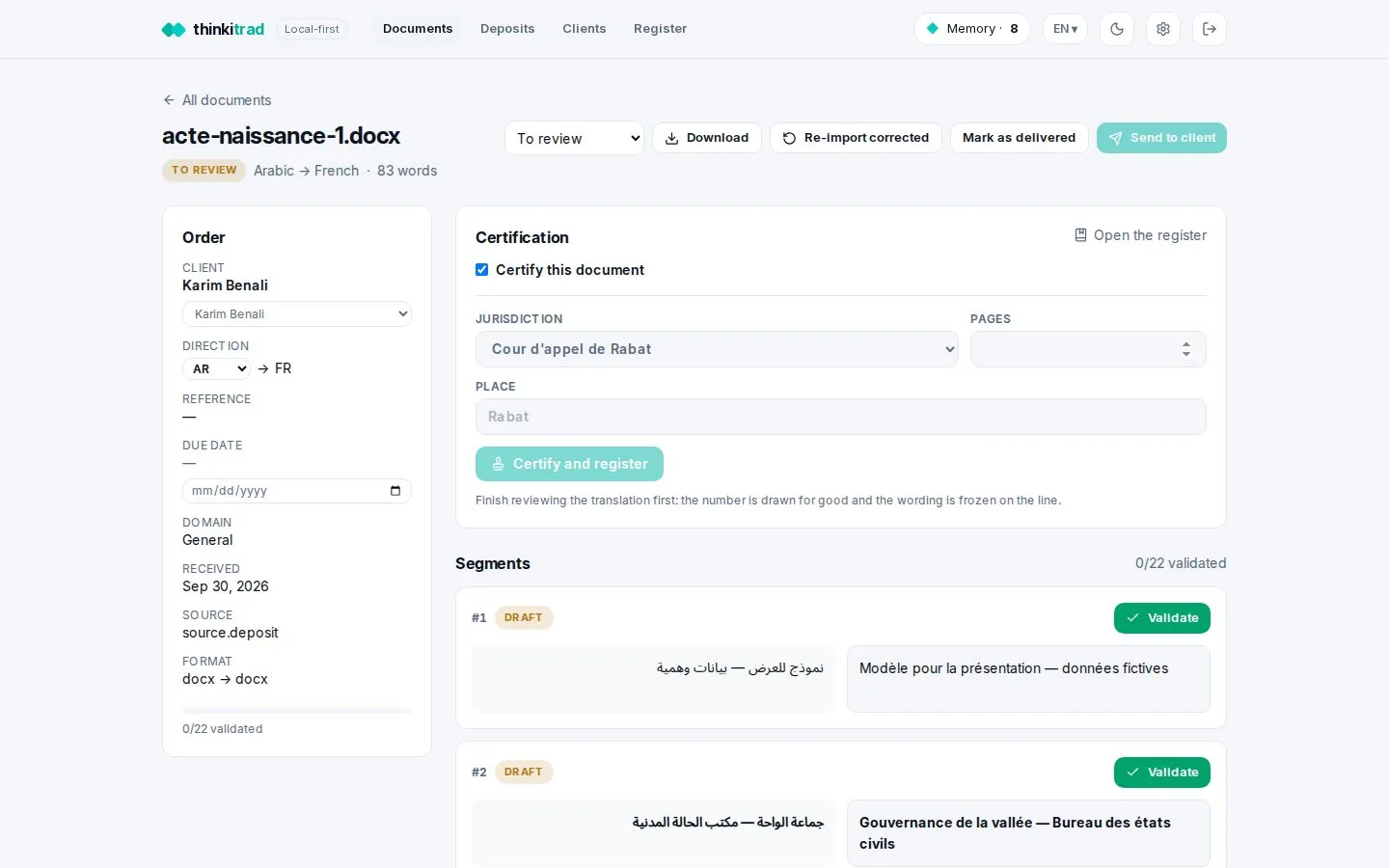
A table stays a table, bold stays bold, and the reading direction follows the target language. A PDF or a photo of a certificate is first rebuilt as a Word document, then translated.
Layout is never left to the AI: it only ever sees the text.
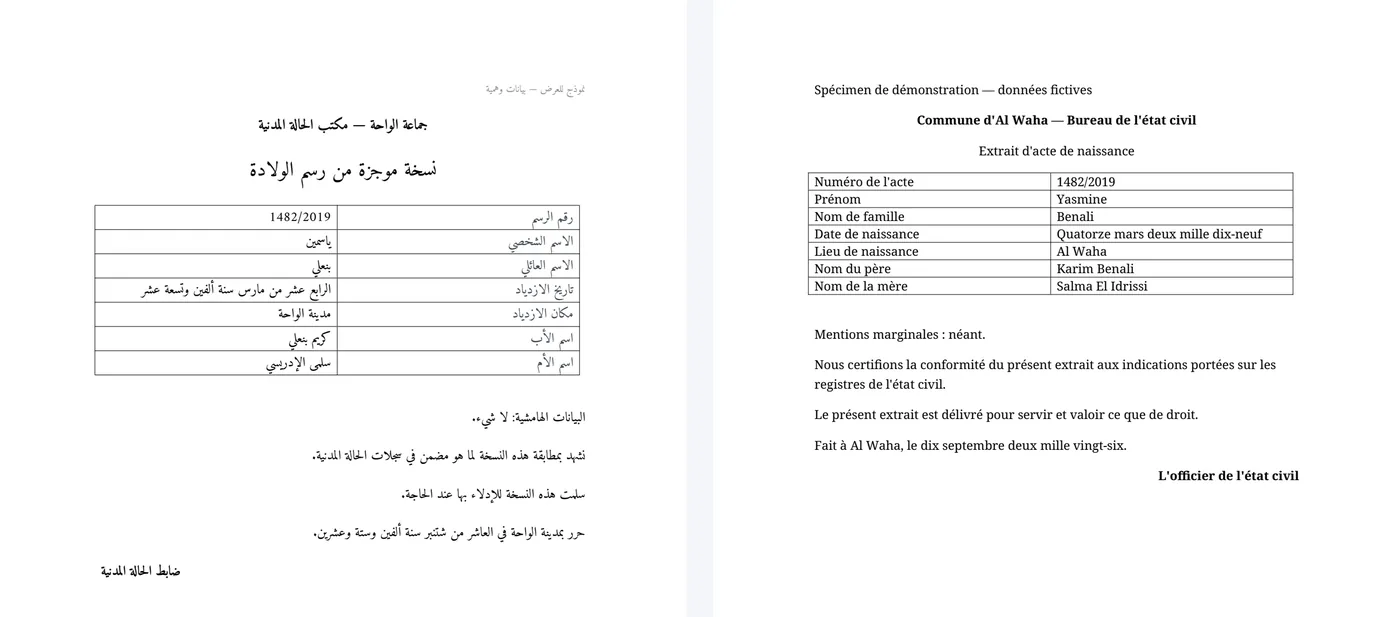
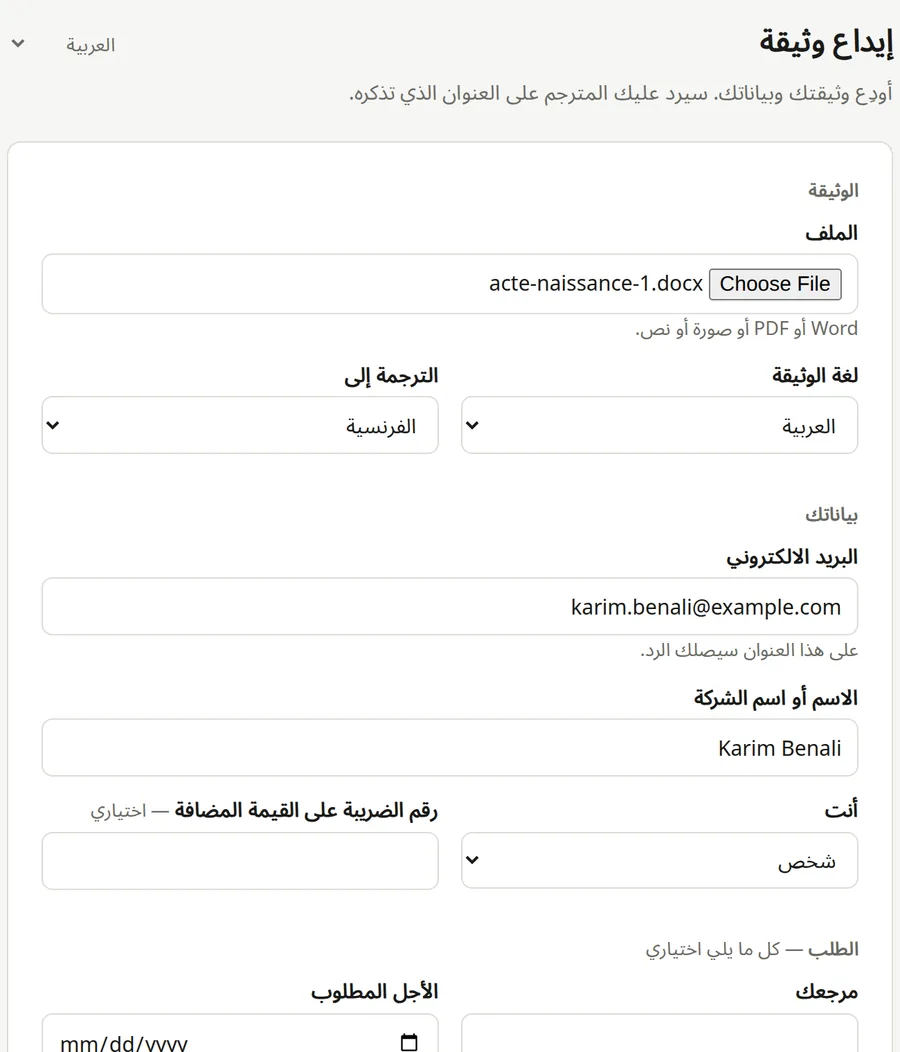
An upload page in your name, in French, English or Arabic. The document waits in your queue with the client record already created; nothing is translated until you accept it.
Clients are matched to their record by email address, never by name.
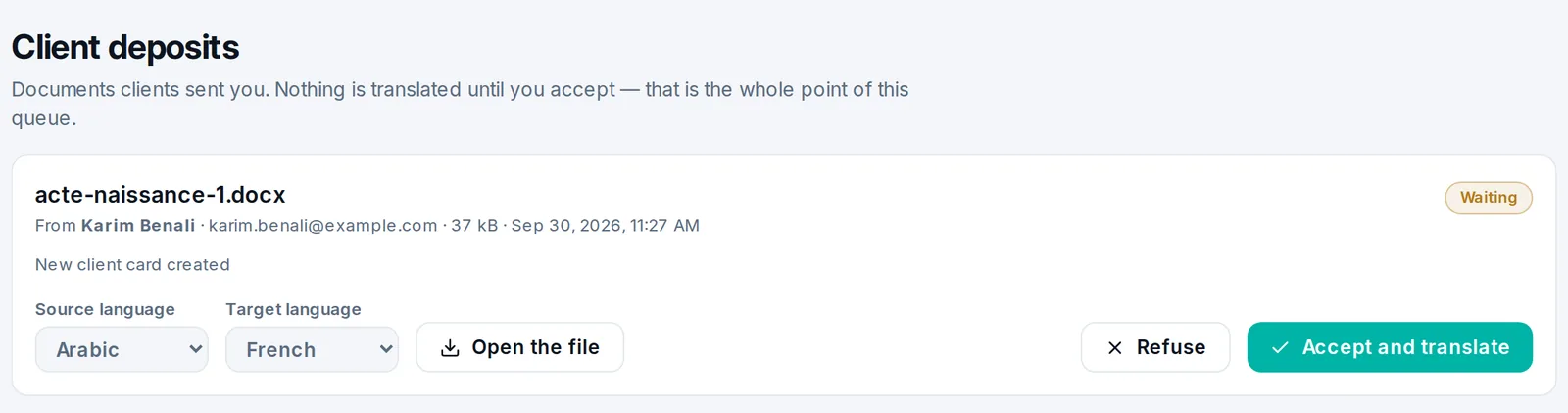
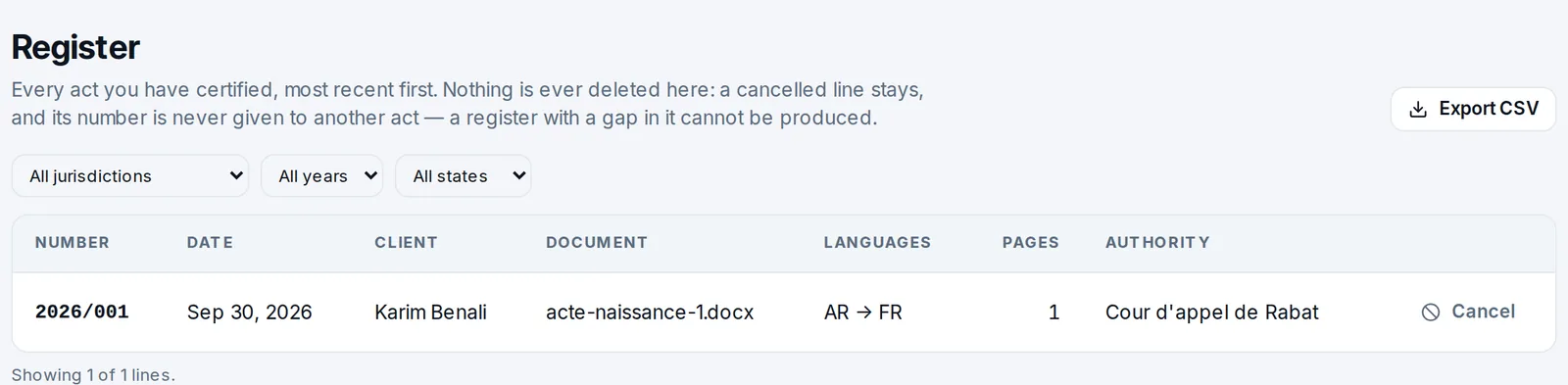
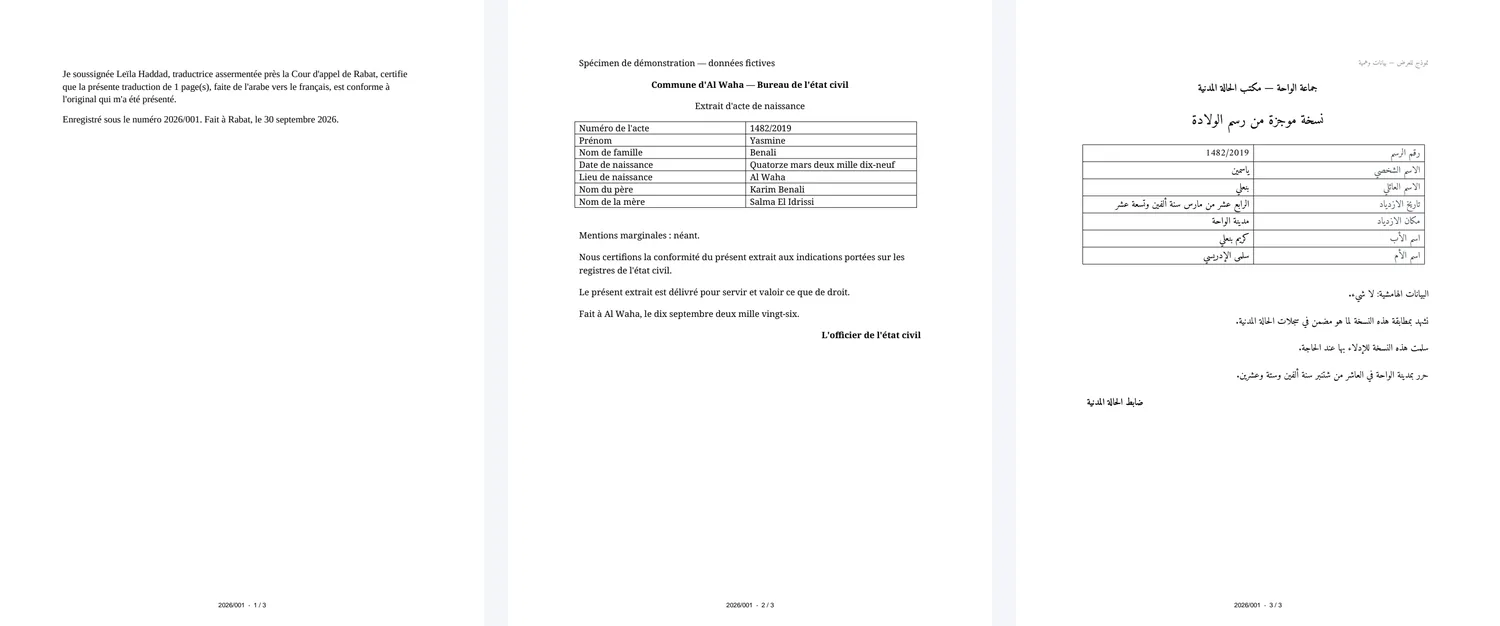
Certification page, translation and a copy of the original, assembled into a single paginated, numbered PDF. The register keeps itself and exports for an inspection.
A cancelled number stays in the register and is never reused.
You send a signed link instead of an attachment: the file only leaves your machine if your client downloads it. The link expires after 48 hours, and you can revoke it.
For a sworn translation, the client receives a copy marked “not certified”, or the scan of the signed original.
Our signature
No retraining, no model changing behind your back: every sentence you validate goes into your memory, and comes back in the documents that follow.
A draft that makes sense, but is far from the set formula.
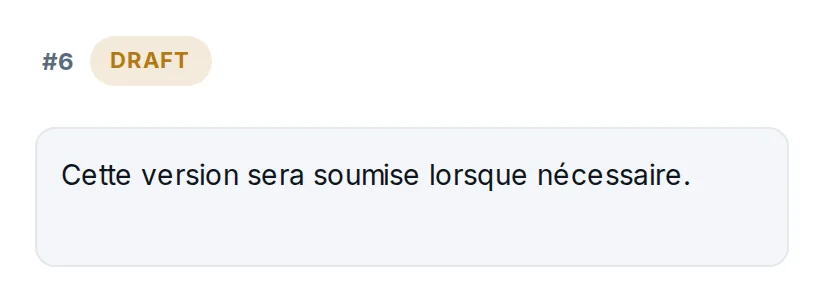
Your set phrase replaces its wording. The pair goes into your memory.
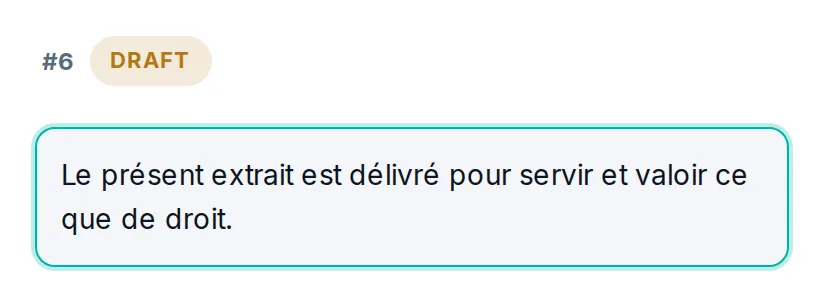
In the following certificate, the sentence comes back at 100%, from memory.
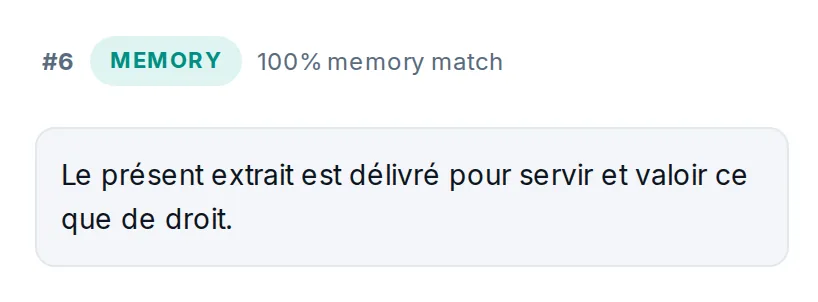
Only what a person has validated is used as an example. An unreviewed draft is never reused: an approximation cannot spread from one file to the next.
Sovereignty
Most “smart” translation tools send your documents to a server you know nothing about. Thinkitrad turns the problem around: the intelligence moves in with you.
The model, scan recognition and your memory. No document is sent to an AI service.
No third party sees their name, their address or their files.
Translation, review and certification all work without a connection.
No subcontractor reading your documents, no transfer out of your office.
| Online service | Thinkitrad | |
|---|---|---|
| The document goes to a third-party server | Yes | Never |
| Your texts may train someone else's model | Depends on the terms | Never |
| Works offline | No | Yes |
| Where your memory lives | With the vendor | On your machine |
Who it's for
One machine per translator, with their own memory, clients and register. Nobody else has an account on it, not even us.
Steady volume, loyal clients
Your recurring documents get faster and faster, and your clients upload their files themselves.
Certificates to certify
Certification, numbering, register and courtesy copy: the translation is ready to sign.
Arabic ↔ French, and other pairs
Reading direction is handled in the layout, not left to chance.
Pilot programme
We are looking for translators to put Thinkitrad to the test on real files, before the commercial launch. You are supported from start to finish, and what you tell us shapes the product.
The machine arrives ready. Your past translations are loaded into the memory before your first document.
You work with the tool before it opens, and your feedback comes first.
A preferential rate kept after launch and close follow-up, in exchange for your feedback.
Only a few places: we take on only what we can support properly.
Questions
Not for translation: the model, scan recognition and memory run on your machine. Only two optional features use the network: the upload page and the download link. Even then, the encrypted connection ends on your machine; the relay that carries it cannot read it.
Yes, but without retraining: what you validate goes into your translation memory, which is then used as an example or reused as is. Only what a person has validated is reused.
Yes: TMX memories (Trados, memoQ…), bilingual spreadsheets (.xlsx, .csv), TBX glossaries, or batches of originals and translations. For those, the tool suggests pairs and you confirm them: nothing is paired without you.
Word (.docx), PDF, images (scans, photos of certificates) and plain text. A PDF or an image is rebuilt as a Word document before translation; you get a Word file back.
The demonstration shows Arabic into French, with right-to-left reading direction. Tell us your language pairs: we check them with you before we start.
An encrypted backup goes out every night to the folder of your choice, an external drive for example. It only counts as done once it has been reopened and checked file by file.
Pilot programme
Tell us your working languages and the kind of documents you receive. You will judge it on a real file, not on a staged demo.